7 July 2019: "how to make / enough room to be in you"
I’ve been a little chicken about posting on my reading blog, so I’m setting a timer for myself and keeping it short and sweet. And as long as it’s semi-coherent, I’ll post it. (This is opposed to going back and working on the bloated unposted work.)
So what have I been reading? Partially, I’ve just been doing activities around reading. Yesterday Britt and I took a day trip to Tivoli, in part to visit The Brother in Elysium Bookstore which our friend Peter has spoken of so highly and which is about to close. It was their last week, so they’ve been selling off a lot without bringing anything in and it was still one of the most amazing bookstores I’ve ever been in. It felt a little bit like visiting the home of my lineage—of New American Writing and onward. All the big hits in beautiful editions and then a really thoughtfully curated collection of a lot of the spiritual or philosophical or historical writings which inspired it (e.g. Carl Sauer because of Olson, etc.).
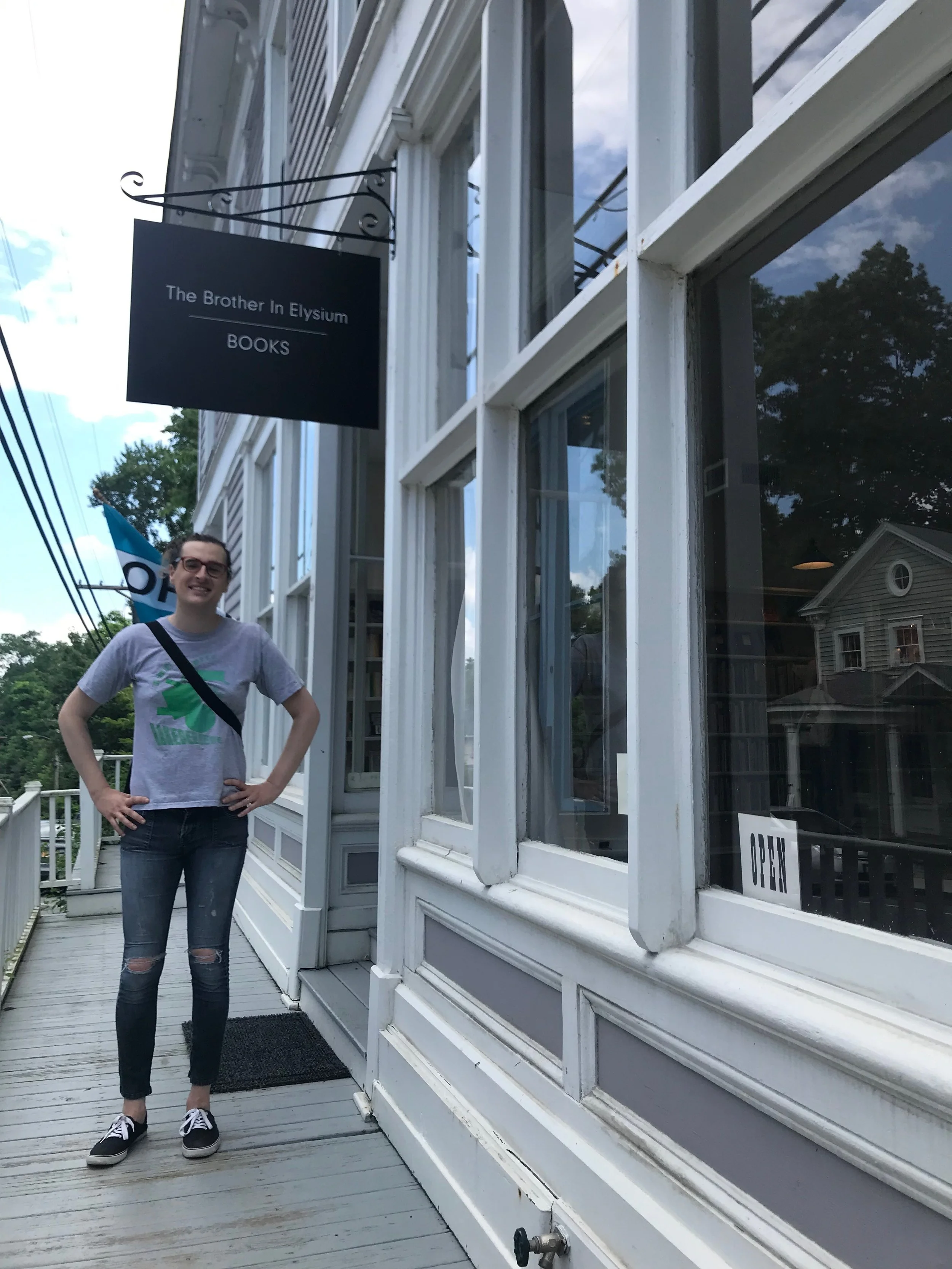
Photo credit Britt Billmeyer-Finn
We picked up a lot of great stuff, for us and for Threshold Academy! As of now, it’s accessible to our At Home library writer in residence (Ell Davis is the inaugural writer) and we’ll put out some of the gems at the next Porch Pop Up on 7/28.
This is in addition to other work that has been flowing in. For my birthday, I treated myself to some Operating System books, both because of a desire to read more Spanish-language poetry (I got the facing page bilingual edition Kawsay: The Flame of the Jungle by María Vázquez (trans. Margaret Randall);) and because of my ongoing collaboration and deepening friendship with Elæ, the Collaborative Precarity Bodyhacking Workbook.
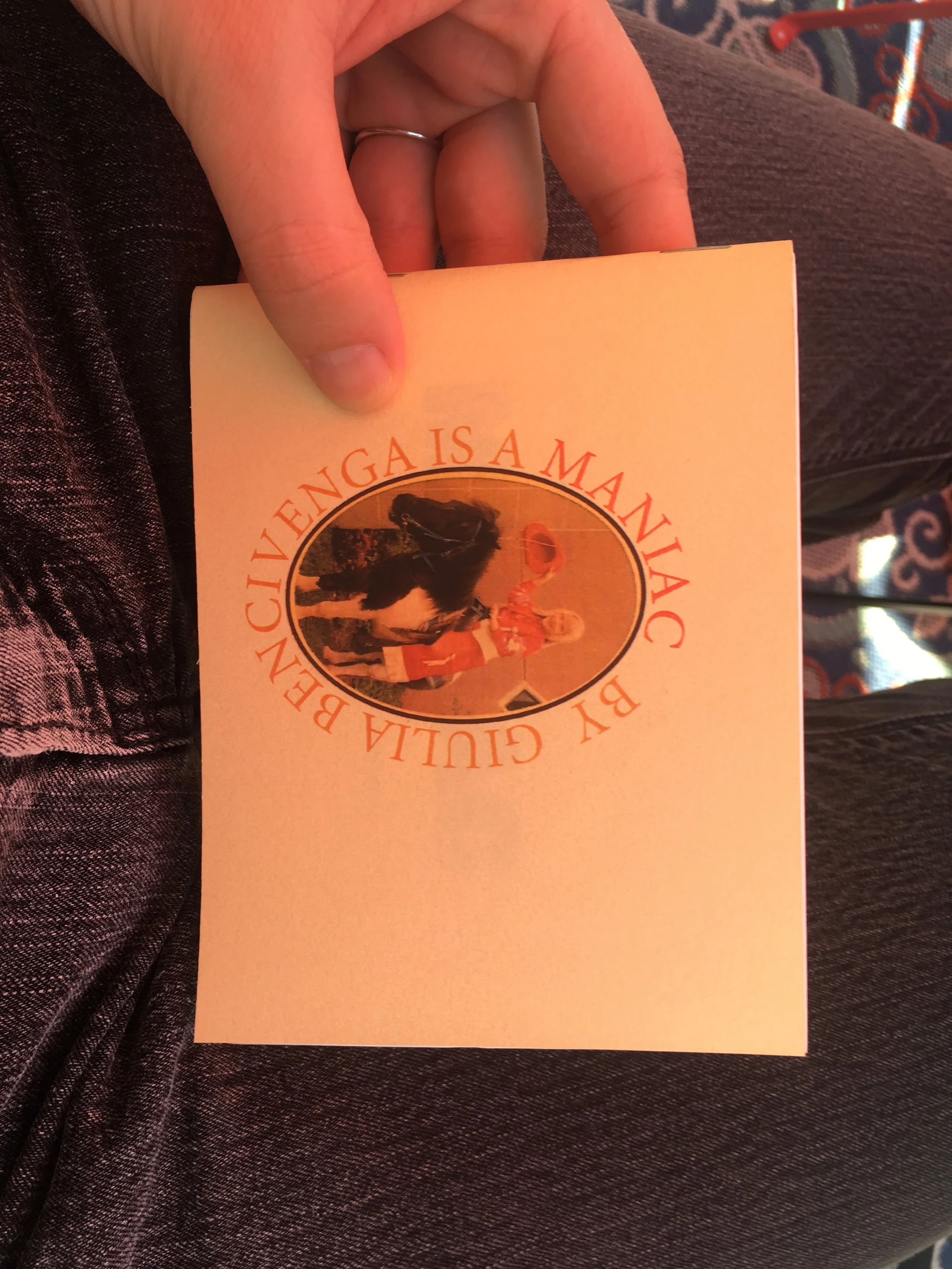
I’m also doing a chapbook swap with the talented poet Giulia Bencivenga, and I received a copy of her Giulia Bencivenga is a Maniac (inpatient press 2019), which I am very excited for!
My friend Tessa is hoping to write a review of Samuel Ace’s Our Weather Our Sea, so I ran a copy of it over to her this morning (Northampton is small—review copies are hand-delivered). She was sitting with a friend who happened to be reading A Wizard of Earthsea, so I had to take a minute to geek out about Le Guin.
But I’m feeling a strong need to balance the furious acquisition with some deep reading. I achieved this a bit the other day, just spending a couple of hours at a café reading A Sand Book by Ariana Reines. I’m at page 145, which, if you haven’t seen this hefty tome, is less than halfway through (the book tops out at around 400 pages—and I love the chutzpah of publishing a poetry book this long “in this day and age”).
I’ve marked a few of my favorite poems and in this spirit of this quick ‘n’ dirty, just get it out there blogging, I’ll just talk about it without any grand plan and see what emerges.
The moment I really committed to A Sand Book is when I reached the poem, “A Partial History.” Reines maps the deleterious psychological effects that "pursuing/our own disintegration,” “Careers as public scolds,” or else as, “A vast unpaid army/Of self-destructors, false comrades, impotent/Brainiacs who wished to appear to be kind” has on us.
Here’s a few lines towards the end:
We were lost in a language of images.
It was growing difficult to speak. Yet talk
Was everywhere. Some of us still sought
To dominate one another intellectually
Others physically; still others psychically or some
Of all of the above, everything seemed to congeal
Into bad versions of sports by other means
And sports by that time was the only metaphor
Left that could acceptably be applied to anything.
The images gave us no rest yet failed over
And over despite the immensity
Of their realism to describe the world as we really
Knew it, and worse, as it knew us (10-11)
This is a question of being and seeming, or in other words TRUTH. And by the end of the first page I was standing with my hat over my heart. I experienced anew the power of description in her take on psychic warfare, created and supported by surplus (of images) and scarcity, not only by admitting that it exists and that Reines herself is a part of it, but also naming it as a prevailing condition of contemporary life.
Other favorites so far include: “Dream House,” “Sandra,” “Magazine Feminism,” “Something Inside Me,” and, “A Valediction Forbidding Mourning.”
Here’s a page from “A Valediction…:”
you must
you must stop lying to yourself
you must drop the rationalizing
or else mercury will stop
being your friend. he has every
right to fuck with you.
My ears perked up at this point, because the D’Aulaire’s book of Greek myths was one of my formative childhood texts, and since childhood I have regarded Mercury, god of liars and thieves as Hannah Arendt calls him (god of lovable rogues as I would call him), as one of my chief patrons. Continuing on:
Saturn would steady, not scold
you if you could learn to stop
flinching when under his eye
& as for the pornographic
suffering manufactured
for us by the television
writers, that suffering
& the serial elaboration
of endurance that seems to make
us feel better about our own
lot, when Uranus dips
back into the sign of the self
he will need a lot of space
figuring out how to make
enough room to be in you
is how the bardic gift
descends the spinal column
reaching down into time
past & time future, digging
down to china, li po
drunk & witnessing himself
in the light moving like a hand
over the mountains. (88)
On my birthday, my mom reminded me that getting older is good, because you care less and less what people think. I guess I bring that up in the context of this passage, because I feel like it contains not only the social/media critique present in “A Partial History” and many other points throughout the book, but also because I can really feel Reines unembarrassedly embracing the sacred spiritual role of poet as chthonic ambassador so as to write poems that are elsewhere’s gifts.
There’s so much hand-wringing about and circumscribing of the role of the poet, and to an extent I feel like it can be healthy to check puffed-up bardic pretensions, but over the past few years I have felt dragged, as if by a strong undertow, further and further away from the solid ground of, well, to use Reines’s own words, figuring out how to make enough room to be in me, so that my bardic gifts can descend my spinal column and reach into time past and time future.
If we can’t do that, what the hell are we doing? So I for one and grabbing hold of A Sand Book and floating back to shore.